
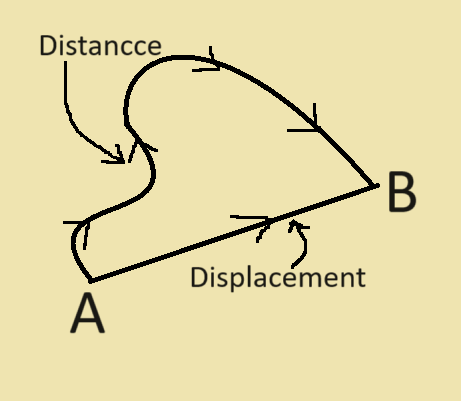
Displacement and distance are two important concepts in physics that are often used to describe the motion of objects. While they may seem similar at first, they actually have distinct definitions and characteristics. In this discussion, we will examine distance and displacement separately, providing examples along the way.
Table of Contents
Distance
Distance is a scalar quantity that refers to the total length of the path traveled by an object between two points. It is a measure of how much path an object has covered and is always positive or zero. Distance is independent of the direction of motion and only concerns itself with the magnitude of the length traveled. For example, if an object travels from point A to point B, the distance would be the actual length of the path taken to reach point B, regardless of any changes in direction.
To illustrate this concept, let’s consider a person taking a walk. Suppose the person walks 2 kilometers to the north and then turns around and walks 3 kilometers to the south before finally returning to their starting point. The total distance covered by the person would be 2 + 3 = 5 kilometers. It is important to note that distance does not take into account the path taken or the changes in direction. It simply measures the total distance covered.
Displacement
Displacement is a vector quantity that refers to the change in position of an object from its initial point to its final point. It not only considers the magnitude but also the direction of the change in position. Displacement is measured by drawing a straight line from the initial point to the final point and measuring the length of that line. Displacement can be positive, negative, or zero, depending on the direction and magnitude of the change in position.
Let’s continue with the example of the person taking a walk. If the person starts at point A, walks 2 kilometers to the north, then turns around and walks 3 kilometers to the south, his displacement would be calculated by drawing a straight line from point A to his final position. In this case, the person would end up 1 kilometer to the south of his starting point. The magnitude of the displacement would be 1 kilometer, and the direction would be south.
It is important to note that displacement is independent of the path taken and only cares about the change in position. It is a more specific and meaningful measurement compared to distance, as it takes into account the final position relative to the initial position.
Examples
Let’s say a car travels 100 kilometers to the east and then turns around and travels 50 kilometers to the west. The total distance traveled by the car would be 100 + 50 = 150 kilometers. However, the displacement of the car would be calculated by drawing a straight line from the initial position to the final position. In this case, the car would end up 50 kilometers to the east of its starting point. Therefore, the displacement of the car would be 50 kilometers to the east.
Another example to highlight the difference between distance and displacement could be the motion on a circular track. Let’s consider a person walking around a circular track.
Suppose the person starts at point A on the track and walks on a circle until he returns back to point A. The distance traveled by the person would be the total length of the circular track. Let’s say the circular track has a circumference of 100 meters. As the person walks around the track, he cover a distance of 100 meters. So, the distance traveled is 100 meters.
However, the displacement of the person would be zero because the person ends up at the same point from where he started. Displacement is the shortest distance between the initial and final points, and since they are the same point in this case, the displacement is zero.
So, in this example of circular motion, the distance traveled is 100 meters and the displacement is zero.
Difference between Displacement and Distance
Here are some key differences between displacement and distance:
1. Scalar vs. Vector: Distance is a scalar quantity as it only has magnitude (numerical value) and no direction. Displacement is a vector quantity as it has both magnitude and direction.
2. Path vs. Straight-line: Distance considers the total length of the path traveled, which can be curved or irregular. Displacement considers the straight-line distance between the initial and final positions, regardless of the path taken.
3. Positive vs. Negative: Distance is always positive or zero, representing the total amount of travel. Displacement can be positive, negative, or zero, depending on the direction of the movement. Negative displacement indicates movement in the opposite direction to the reference point.
4. Net Effect vs. Full Picture: Distance tells us the total ground covered by an object without indicating the direction or final position. Displacement provides information about the starting and ending positions, as well as the direction of the object’s motion.
Summarized
In summary, distance is a scalar quantity that measures the total length of the path traveled, regardless of direction, while displacement is a vector quantity that measures the change in position, considering magnitude and direction. Distance is independent of direction but displacement takes into account the final position relative to the initial position.
Questions
Q1: What is the difference between displacement and distance in physics?
A: Distance is the total length of the path traveled by an object, regardless of direction, and is a scalar quantity. Displacement, on the other hand, is the straight-line distance between the starting and ending points of an object’s journey, along with the direction, making it a vector quantity.
Q2: How is displacement calculated, and how does it differ from distance?
A: Displacement is calculated by finding the vector difference between the final and initial positions of an object. Mathematically, it is represented as 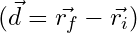 , where
  is the final position and
  is the initial position. Unlike distance, which is a scalar and only considers magnitude, displacement takes into account both magnitude and direction.
Q3: Can displacement be zero even if distance traveled is not? Explain with an example.
A: Yes, displacement can be zero even if the distance traveled is not. For example, if a person walks around a circular track and returns to the starting point, the distance traveled is the circumference of the track, but the displacement is zero because the starting and ending points are the same.
Q4: Why is displacement considered a vector quantity while distance is a scalar quantity?
A: Displacement is considered a vector quantity because it has both magnitude and direction, indicating the change in position from the starting point to the ending point. Distance, however, only measures the magnitude of the path traveled without considering direction, making it a scalar quantity.
Q5: How can we represent displacement and distance graphically on a position-time graph?
A: On a position-time graph, distance is represented by the total length of the path traced by the object’s motion over time, regardless of direction. Displacement is shown as the straight-line distance between the initial and final positions on the graph, considering the direction from the starting to the ending point.
Q6: What are some real-life examples that illustrate the concept of displacement and distance?
A: Real-life examples include:
- A car driving around a city block and returning to the same spot: The distance traveled is the perimeter of the block, but the displacement is zero.
- A hiker walking from one campsite to another in a straight line: The distance and displacement are the same, equal to the straight-line distance between the campsites.
- A runner completing a lap on a track: The distance is the length of the track, but the displacement is zero if the runner finishes at the starting point.
Q7: How does the concept of displacement apply in circular motion?
A: In circular motion, displacement is the straight-line distance between the starting and ending points along with the direction. For example, if an object completes a full circle, the displacement is zero because it returns to its starting point. If it only completes half a circle, the displacement is the diameter of the circle in a straight line across the circle.
Q8: In what scenarios would the displacement and distance of an object be the same?
A: Displacement and distance are the same when an object moves in a straight line without changing direction. For example, if a person walks 5 meters east, both the distance traveled and the displacement are 5 meters east.
Q9: How do GPS systems use the concepts of distance and displacement to track movement?
A: GPS systems use the concept of distance to measure the total path traveled by a user, which is important for tracking routes and distances covered. Displacement is used to determine the straight-line distance between the starting point and the current position, which helps in navigation by providing the most direct route to a destination.
Q10: What role do displacement and distance play in determining the shortest path in navigation?
A: In navigation, displacement helps in identifying the shortest straight-line path between two points, which is crucial for efficient route planning. Distance provides information on the actual path taken, which is important for understanding the total travel length and time. By comparing displacement with distance, navigational systems can optimize routes to minimize travel distance and time.
See the animation of displacement and distance here.
Read also Rest and Motion
