In this post we will be discussing about rest and motion. What does it mean and how they are related to one another. Also we will explain it with the help of examples.
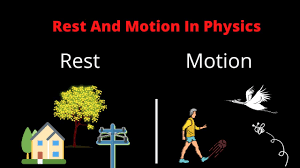
Table of Contents
Rest
Rest is a state or condition of inactivity, where an object or body remains stationary or does not experience any change in position or movement. Rest refers to the absence of motion and the absence of any external force or energy acting on an object. In rest, an object has a constant position relative to its surroundings and does not exhibit any movement or change in its physical state. Rest can also be used to describe a state of relaxation or peacefulness in living organisms, where they are not exerting physical or mental effort.
Motion
Motion is the act or process of changing position or location with respect to a reference point. It involves a change in the position of an object over time with respect to its surroundings and can occur in various ways such as translational motion (straight line motion), rotational motion (movement around an axis), or oscillatory motion (back and forth movement). Motion can be described in terms of speed (how fast an object is moving), velocity (speed with direction), and acceleration (rate of change in velocity). It is a fundamental concept in physics and is observed in all aspects of the universe, from the movement of celestial bodies to the basic actions of daily life.
https://www.britannica.com/science/motion-mechanics
Difference between Rest and Motion
Rest and motion are two contrasting states of an object or body. The main difference between rest and motion can be understood in the following points:
- State: Rest refers to the state of an object when it is not changing its position with respect to its surroundings or when its velocity is zero. In other words, an object in rest will have zero displacement and zero velocity. Motion, on the other hand, refers to the state of an object when it changes its position with respect to its surroundings. It involves a change in displacement and velocity.
- Reference point: Rest and motion are always observed and described with respect to a reference point. The reference point can be fixed or moving. In rest, the object remains at a fixed position with respect to the reference point, while in motion, the object changes its position relative to the reference point.
- Displacement: Displacement refers to the change in position of an object from one point to another. In rest, the object has a zero displacement, as it does not move. In motion, the object has a non-zero displacement, as it changes its position. Read more about Displacement and Distance.
- Velocity: Velocity is the rate of change of displacement with respect to time. In rest, the object has a zero velocity, as it does not change its position. In motion, the object has a non-zero velocity, as it moves from one position to another.
- Energy: Rest and motion can also be related to the energy of an object. In rest, an object possesses potential energy, while in motion, it possesses both potential and kinetic energy.
- External forces: The occurrence of rest or motion can be attributed to the presence or absence of external forces acting on an object. In rest, the forces acting on the object are balanced, resulting in no motion. In motion, there is an unbalanced force acting on the object, causing it to move.
- Observational Standpoint: Rest and motion are relative concepts, depending on the perspective of the observer. An object may appear to be at rest to one observer but in motion to another observer, especially if their reference points are different.
In summary, rest refers to the state of an object when it is not changing its position, while motion refers to the state of an object when it is changing its position. The main differences lie in displacement, velocity, energy, external forces, and the observational standpoint.
Example
Let’s take the example of the Sun, Earth, and a human to understand motion and rest as relative terms. From the perspective of the Sun, the Earth is in motion because it orbits around the Sun. The Sun sees the Earth continuously moving in a circular path, and therefore it considers the Earth to be in motion.
However, from the perspective of an observer on Earth, it may appear that the Sun is in motion because it appears to rise in the east and set in the west. This is due to the rotation of the Earth on its axis, which gives the illusion of the Sun moving across the sky.
Now, let’s consider the motion or rest of a human on Earth. If a person is sitting still on the ground, they may perceive themselves to be at rest. However, from the perspective of an observer on the Sun, the person would still be in motion due to the Earth’s rotation and its orbit around the Sun.
Similarly, if the person is walking or running, they perceive themselves to be in motion relative to the ground. However, from the perspective of an observer in space, both the person and the Earth are in motion.
Therefore, motion and rest are relative terms. Whether an object or person is considered to be in motion or at rest depends on the reference point or frame of reference from which it is observed.
Questions
Q1: What is the difference between rest and motion in physics?
A: In physics, an object is said to be at rest if it does not change its position relative to its surroundings over time. Conversely, an object is in motion if it changes its position relative to its surroundings over time.
Q2: How can we tell if an object is in motion or at rest?
A: We can determine if an object is in motion or at rest by using a reference point. If the object’s position changes relative to the reference point, it is in motion. If the position does not change, it is at rest.
Q3: What are some examples of objects at rest and objects in motion?
A: Examples of objects at rest include a book lying on a table, a parked car, and a sleeping dog. Examples of objects in motion include a moving car, a flying bird, and a rolling ball.
Q4: How does the concept of a reference point help us understand motion?
A: A reference point is a fixed place or object used to determine the position of an object. By comparing the position of an object to the reference point over time, we can understand whether the object is in motion or at rest.
Q5: What are the different types of motion, and how are they classified?
A: The different types of motion include linear motion (movement in a straight line), rotational motion (movement around a central point), and periodic motion (repetitive movement in a regular pattern). They are classified based on the path the object takes and the nature of the motion.
Q6: How does speed relate to motion, and how can we calculate it?
A: Speed is a measure of how fast an object is moving. It relates to motion by quantifying the rate at which an object changes its position. Speed can be calculated using the formula: speed = distance / time.
Q7: What is the difference between uniform motion and non-uniform motion?
A: Uniform motion occurs when an object moves at a constant speed in a straight line. Non-uniform motion occurs when an object’s speed or direction changes over time.
Q8: How does gravity affect objects at rest and in motion?
A: Gravity pulls objects toward the Earth, affecting both those at rest and in motion. For objects at rest, gravity keeps them anchored to the ground. For objects in motion, gravity influences their trajectory and can cause them to accelerate downwards.
Q9: What role does friction play in the motion of objects?
A: Friction is a force that opposes the motion of objects. It acts between surfaces in contact, slowing down moving objects and eventually bringing them to rest. Friction also helps objects at rest to remain stationary by providing resistance against movement.
Q10: How do we use graphs to represent and analyze motion?
A: We use position-time graphs and velocity-time graphs to represent and analyze motion. A position-time graph shows how an object’s position changes over time, while a velocity-time graph shows how an object’s velocity changes over time. These graphs help us visualize and understand the nature of an object’s motion.
